Business Manager Holders Have Until 16 October 2028 to Meet the ¥30 Million Rule
Japan's revised Business Manager criteria carry a transitional window that closes on 16 October 2028, and permanent residence applications are excluded from it.
41posts
Japan's revised Business Manager criteria carry a transitional window that closes on 16 October 2028, and permanent residence applications are excluded from it.
A state-run survey reported on 23 October 2026 found that about 36% of the organisations expected to deliver Japanese-language training under Employment for Skill Development have no teacher lined up, ahead of the status's April 2027 start.
Designated clinics in Indonesia start accepting bookings for Japan's pre-entry tuberculosis screening on 2 November 2026, and from 4 January 2027 a certificate of no active tuberculosis must accompany a certificate of eligibility or visa application, while residents returning on a re-entry permit stay outside the programme.
Two amendments to the Designated Activities notice add Panama to Japan's working holiday system from 1 November 2026 and Brazil from 1 December 2026, though neither country's age range, quota or paperwork has been published yet.
A draft put to the expert panel on 19 October 2026 would move medical and welfare facility catering out of the suspended Specified Skilled Worker food service field and into food and beverage manufacturing from FY2027.
The Immigration Services Agency is consulting on deleting a designated-activities category that has had no users since 2018, with comments closing on 29 October 2026.
The Immigration Services Agency's entry and departure figures for the first half of 2026, published on 16 October 2026, show foreign arrivals up 0.3 per cent to 21,447,220 while first-time entries fell to 19,706,953, leaving roughly 1.74 million entries by residents returning from abroad.
The Immigration Services Agency's updated Employment for Skill Development Q&A sets out the conditions for a worker-initiated change of employer from 1 April 2027, including a restriction period of one to two years set by sector and a compensation payment whose amount has not yet been issued.
Japan's half-year immigration statistics, released on 16 October 2026, show a record 4,281,026 foreign residents at the end of June, a 4,034-holder drop in the Business Manager status, and overstayers down 4.8 per cent.
From 1 April 2027 one support staffer may cover fewer than 50 Specified Skilled Worker (i) workers and, at a registered support organisation, fewer than 10 client employers, while organisations whose registration expires by 31 July 2027 must file renewals before that date to be judged under the current rules.
The Immigration Services Agency has consulted on adding a five-year period of stay to Specified Skilled Worker (ii), with the government planning a January 2027 start, while the five-year cumulative cap on Specified Skilled Worker (i) stays where it is.
The Immigration Services Agency is consulting on adding dental technicians and speech-language-hearing therapists to the Medical status of residence, with comments due by 15 October 2026 and the change planned for November 2026.
The Immigration Services Agency has set 1 April 2027 as the start of the "B1 or above" Japanese standard for Specified Skilled Worker certificate of eligibility applications, and says the timing for change-of-status and renewal applications is still under consideration.
Residents in hardship can pay ¥10,000 for an extension and ¥20,000 for permanent residence under measures in force since 1 October 2026, but the online application system does not process the reduction.
The Employment for Skill Development programme begins on 1 April 2027, the employer and supervising-organisation filing windows are already open, and the Immigration Services Agency confirms that Technical Intern Training holders cannot transfer into it.
The Immigration Services Agency issued the revised permanent residence guidelines and new revocation guidelines on 1 October 2026; most of the text applies from 1 April 2027, but the income and public-burden provisions reach applications already filed.
The Immigration Services Agency's end-June 2026 figures put Specified Skilled Worker residents at a record, with food service at 98.1 per cent of a ceiling that has been closed to new entrants since 13 April 2026.
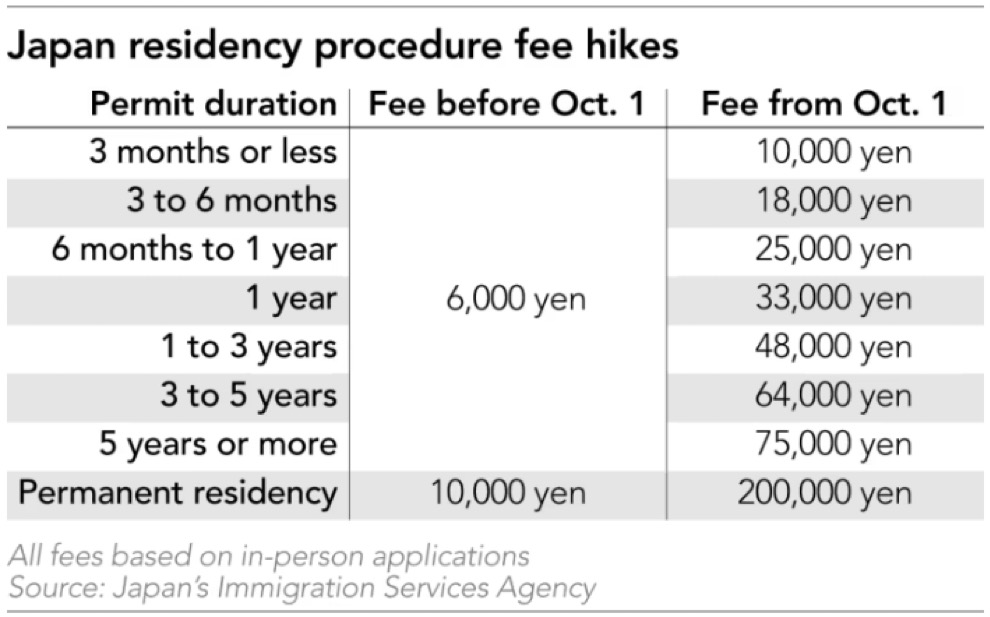
From 1 October the fee for a renewal or status change is not only larger but paid differently, and the online route carries a settlement surcharge the hardship reduction cannot reach.
The education ministry and the Immigration Services Agency have asked language schools to point students at tests other than the JLPT, after the December sitting in Japan closed early for lack of seats.
Narita's two largest terminals began joint immigration-customs kiosk operations on 24 September. The customs half applies to residence card holders in full; the immigration half does not work the same way.
The Immigration Services Agency warned on 24 September about fraudulent emails demanding residence application fees, days before online applicants start paying by convenience store or bank transfer.
Applications accepted on or before 30 September keep the current fees. From 1 October a renewal costs between ¥10,000 and ¥75,000, and permanent residence goes to ¥200,000.
The government presented a plan on 9 September to open the aviation field to Ikusei Shuro. The programme's overall ceiling does not move, so the new field draws on the existing allocation.
The Immigration Services Agency published a reinforced Zero Overstayers package at the end of August, while figures showed nearly 1,000 Business Manager visa holders left Japan in the first half of 2026.
The Immigration Services Agency published the new fee schedule in late August. A flat ¥6,000 renewal becomes a scale running to ¥75,000, and permanent residence goes from ¥10,000 to ¥200,000.
The Immigration Services Agency opened consultation in August on two documents: revised permanent residence approval guidelines, and the first guidelines on when permanent residence can be revoked.
The Justice Ministry published a new Basic Plan for Immigration Control in July — the document that frames immigration policy for the years ahead, including JESTA by 2028.
Reports in late July set out the government's intended permanent residence criteria — household income above the national average, pension equivalent to 30 years of enrolment, and a language test.
A Justice Ministry project team set out in July how a structured programme teaching Japanese and the country's rules would work — the mechanism behind January's panel recommendation.
From 14 June 2026 mid- to long-term residents can apply for a single card combining residence card and My Number card functions. It is optional, and there are reasons to think about it.
Japan signed a memorandum of cooperation with Thailand on the Ikusei Shuro programme in June, part of the bilateral groundwork that has to be in place before the 2027 start.
A run of Immigration Services Agency notices in late May covered the new residence card design, photo rules for children, Specified Skilled Worker reporting, and the questions the agency is fielding most on keiei kanri.
Six months after Japan raised the capital and staffing bar for the Business Manager visa, a survey of foreign entrepreneurs shows how many are struggling to requalify at renewal.
From 15 April 2026 applicants for Engineer/Specialist in Humanities/International Services status must show Japanese-language proficiency. The status covers more than 475,000 people.
The Immigration Services Agency released the operating manual for Ikusei Shuro, the programme replacing technical intern training from April 2027, along with revised standards for two Specified Skilled Worker sectors.
The Immigration Services Agency's end-2025 figures put the foreign resident population at 4,125,395 — up 9.5% in a year, and the first time the total has cleared four million.
The Immigration Services Agency revised how it assesses permanent residence applications in late February, putting more weight on tax, pension and public-charge conduct.
The Immigration Services Agency's preliminary count of foreign arrivals and Japanese departures for 2025 sets the baseline for this year's border policy arguments.
A government expert panel's final report in January 2026 recommended structured language and civics learning for foreign residents, and floated tying it to long-term status.
The Future Creation Individual (J-Find) route lets graduates of highly ranked universities job-hunt in Japan for up to two years. The qualifying list was refreshed in January 2026.
Worker intake targets, a naturalisation review and a fee overhaul were all settled before the year began. Here is what foreign residents in Japan should expect in 2026.