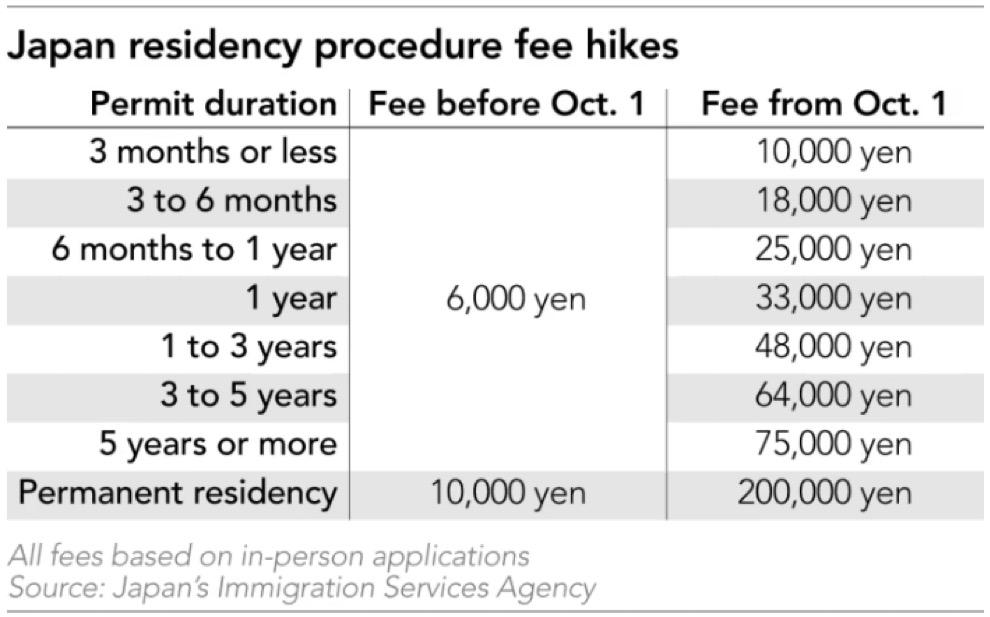
From Thursday, 1 October, a residence renewal or status change in Japan does not only cost more — it is paid differently. Applicants using the online system will settle by convenience store or bank transfer and will be charged a settlement fee of ¥330 or ¥550 on top of the fee itself, while applicants at an immigration counter carry on buying revenue stamps as before.
The Immigration Services Agency has now published the payment mechanics alongside the new fee schedule, and two details cut against the assumption that filing online is always cheaper.
The two scales, side by side
For a change of status or an extension, the fee is keyed to the period of stay actually granted, not the period requested. At the counter: ¥10,000 for three months or less, ¥18,000 for over three to six months, ¥25,000 for over six months to under a year, ¥33,000 for one year, ¥48,000 for over one to under three years, ¥64,000 for three to under five years, ¥75,000 for five years or more.
The online scale is lower at every band above the lowest: ¥10,000, ¥15,000, ¥21,000, ¥27,000, ¥42,000, ¥56,000, ¥65,000.
Permanent residence permission goes from ¥10,000 to ¥200,000.
The online discount is smaller than the headline
Online payments carry a settlement fee on top: ¥330 on the lower bands, ¥550 on the top two. A three-month grant therefore costs ¥10,330 online against ¥10,000 at the counter, the one band where filing online is more expensive. Five years or more comes to ¥65,550 online against ¥75,000 at the counter.
Credit cards and QR-code payment are not accepted. The agency's page is explicit: convenience store or bank transfer only, with internet banking available through the bank route.
No paper bill arrives
The agency will not post a payment notice. After a decision is reached, settlement instructions arrive by email from the domain @service-dgft.com, and that email is the only thing telling an online applicant what to pay and how.
The agency warned on 24 September about fraudulent emails demanding residence application fees, and a system whose only legitimate bill arrives from an unfamiliar third-party domain makes a convincing fake easy to build. Check the domain character by character before paying, and treat any message asking for card details as fake: the real route cannot take a card.
The hardship reduction is counter-only
Applicants living in poverty at a level comparable to welfare recipients can apply for a reduced fee: ¥10,000 for a change of status or an extension, ¥20,000 for permanent residence. Eligibility covers welfare recipients, people receiving recent support payments, Chinese returnees on support allowances, and low-income applicants who can document it with a tax certificate and bank statements.
The reduction cannot be claimed through the online system, so anyone who qualifies has to file at a window. For a five-year grant the reduced counter fee of ¥10,000 sits far below the ¥65,550 the online route would charge. If you may qualify, the online discount is the wrong thing to optimise for.
If you hold a residence card, 30 September is the line
The old fees attach to the date an application is received, not the date it is decided. An application accepted on or before 30 September pays ¥6,000 at the counter or ¥5,500 online even if the permission comes through in November.
If your current period of stay lets you file now, filing today saves real money: on a five-year renewal, the difference between ¥6,000 and ¥75,000. What changes on 1 October is set out on our page covering the 2026 fee changes, and the procedural requirements are on the page for extending and renewing status of residence.
Short-stay visitors are not affected by this
These are domestic residence-procedure fees, charged to people already holding a residence card who are changing or extending their status. Someone arriving for a short visit pays nothing of the sort.
Visitors who need a visa pay a consular fee at a Japanese embassy or consulate, ¥15,000 single-entry and ¥30,000 multiple-entry since 1 July 2026, and nationals of the visa-exempt countries pay nothing for a short stay. That is separate legislation administered by a different ministry, and nothing about it changes on 1 October.
Residents planning a renewal in the next few months should work out what period of stay they are likely to be granted before deciding how to file. The band, not the application type, sets the bill.
Sources: Immigration Services Agency — fee amounts and payment methods for online applications, Immigration Services Agency — revision of residence permission fees from 1 October 2026, Immigration Services Agency — reduction and exemption of residence permission fees, Immigration Services Agency — fee revision leaflet (PDF)